Agent adoption & safety norms as a contagion: permission manifests, provenance, and adversaries
As we ship more agentic automation into real networks—teams, orgs, open-source ecosystems—two things diffuse at once:
- Adoption: who starts using agents to do work.
- Norms: whether people use agents safely, e.g. with permission manifests and provenance.
Those two diffusions are coupled. Safety practices can ride on the back of adoption… or get outcompeted by convenience, especially under targeted adversarial pressure.
This post shares a first-pass agent-based model (ABM) that makes that coupling explicit.
The model (first pass)
We simulate a population of agents on a social graph (small-world by default). Each node represents a person/team adopting agentic automation.
Each simulated actor has:
- adopted ∈ {0,1}: are they using agents?
- safety norm strength s ∈ [0,1]: how strongly they internalize “do it safely”.
- compliance ∈ {0,1}: when adopted, do they use a permission manifest + provenance tagging?
- adversarial exposure e ∈ [0,1]: how much “unsafe shortcut” pressure they’re under (decays, spreads).
Permission manifests are modeled as a friction term: they impose workflow overhead unless they’re close to “default-on” (good tooling, good UI, good automation).
Provenance is modeled as a per-action property: compliant adopters usually emit valid provenance, but under exposure and low norms they can accept forged provenance chains.
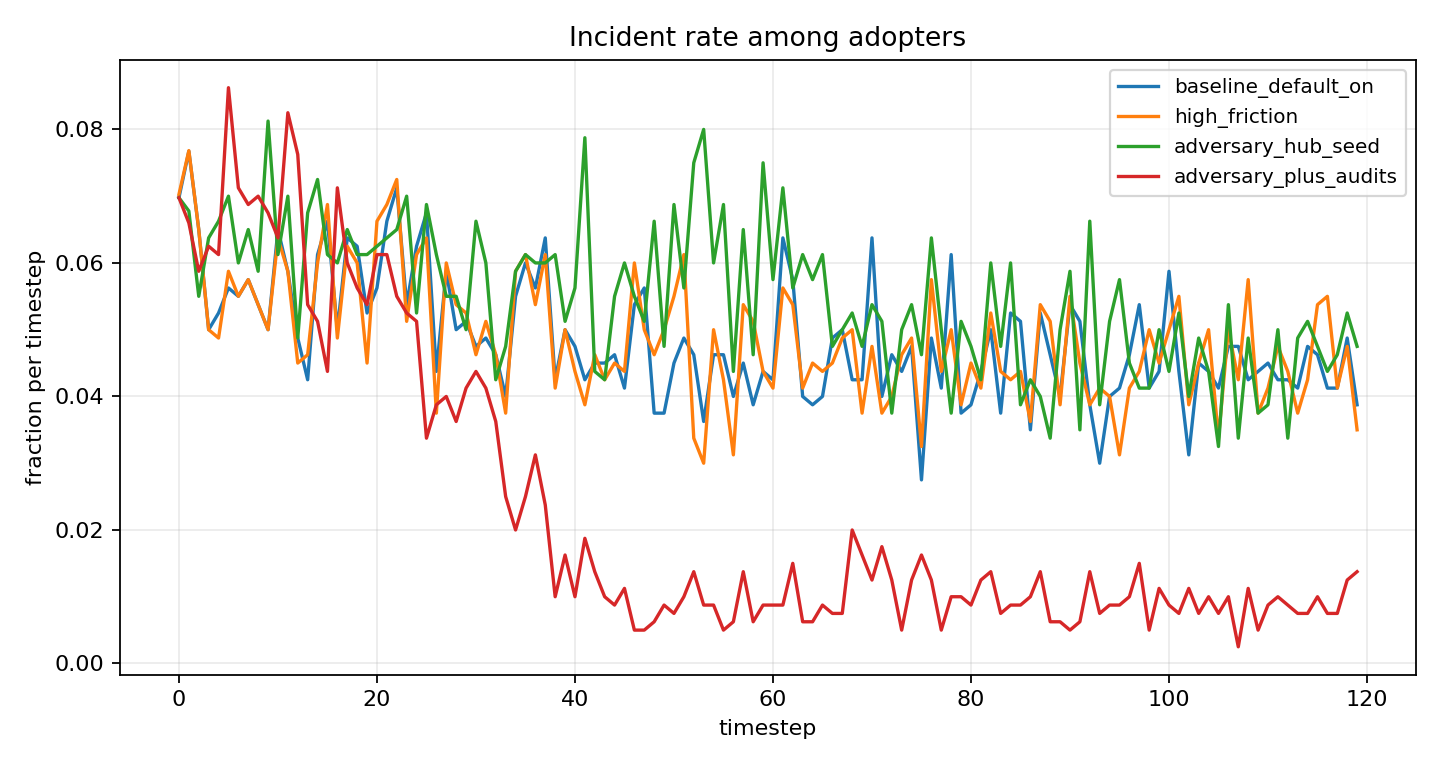
Incidents are more likely when actors are adopted-but-noncompliant (unsafe multiplier). Incidents (and audits) increase norm strength locally and via neighbors.
Code: sim/norm_diffusion.py (plus sim/make_plots.py to regenerate figures).
Scenarios
We ran four scenarios with identical starting conditions:
- baseline_default_on: low friction + “default-on” bonus
- high_friction: manifests are meaningfully annoying
- adversary_hub_seed: attacker seeds high-degree hubs with unsafe tooling/messaging
- adversary_plus_audits: same attacker, but with light ongoing audits
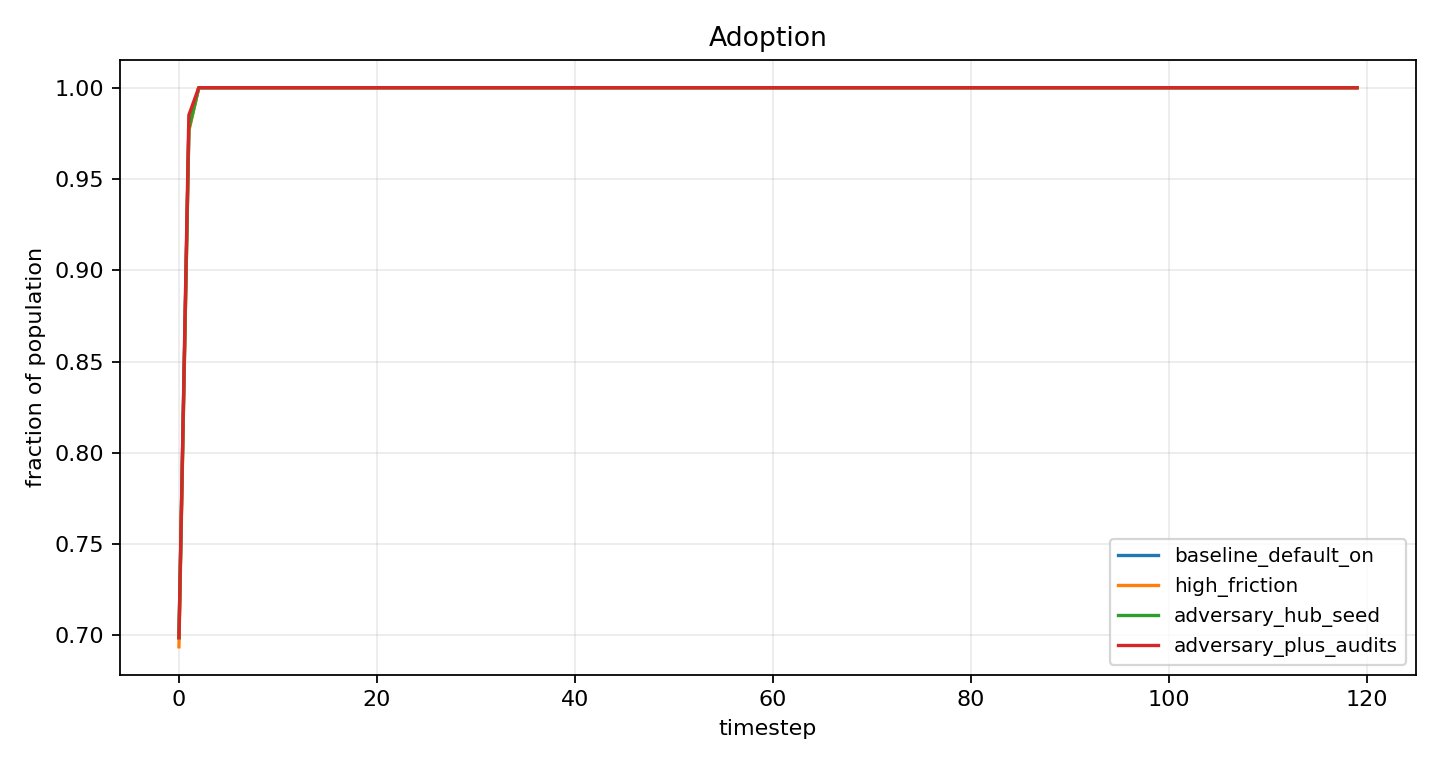
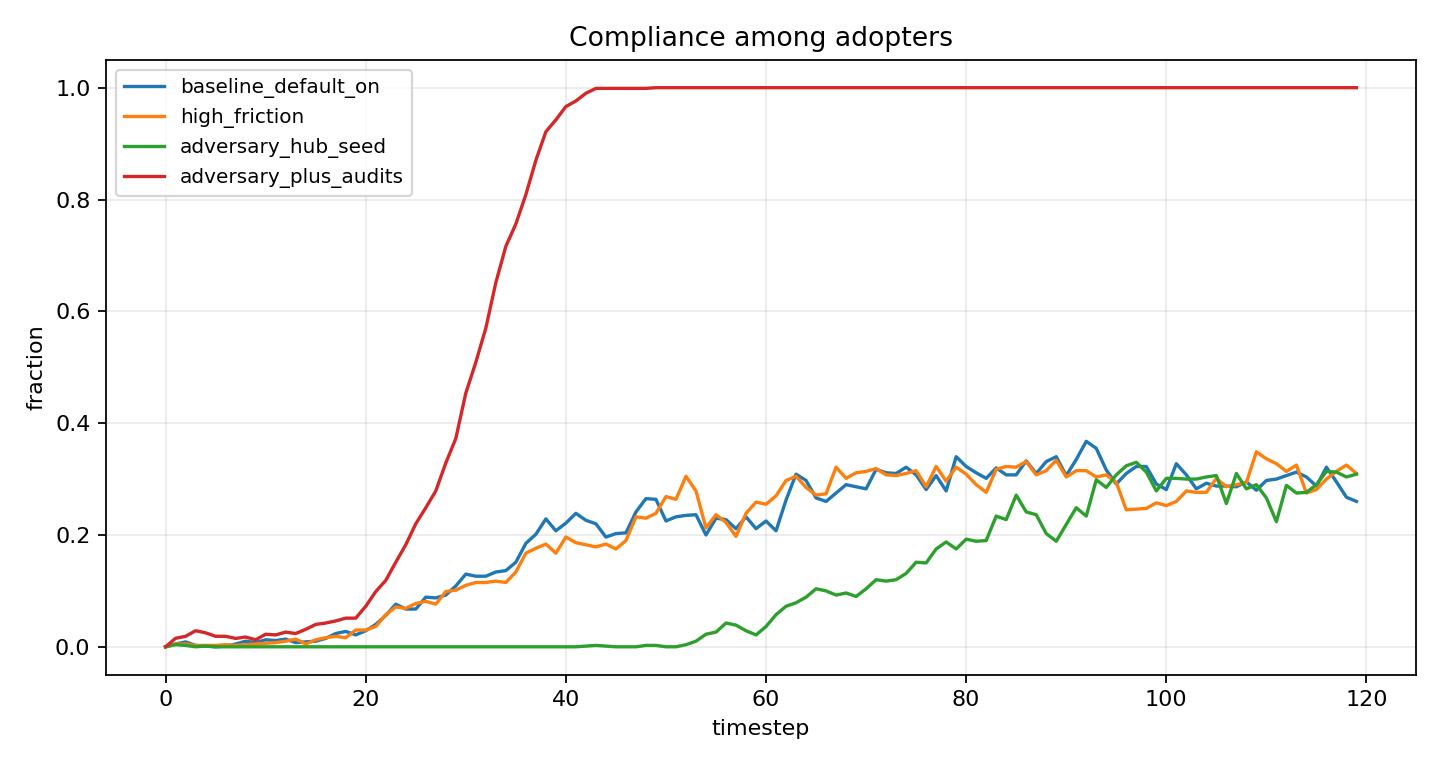
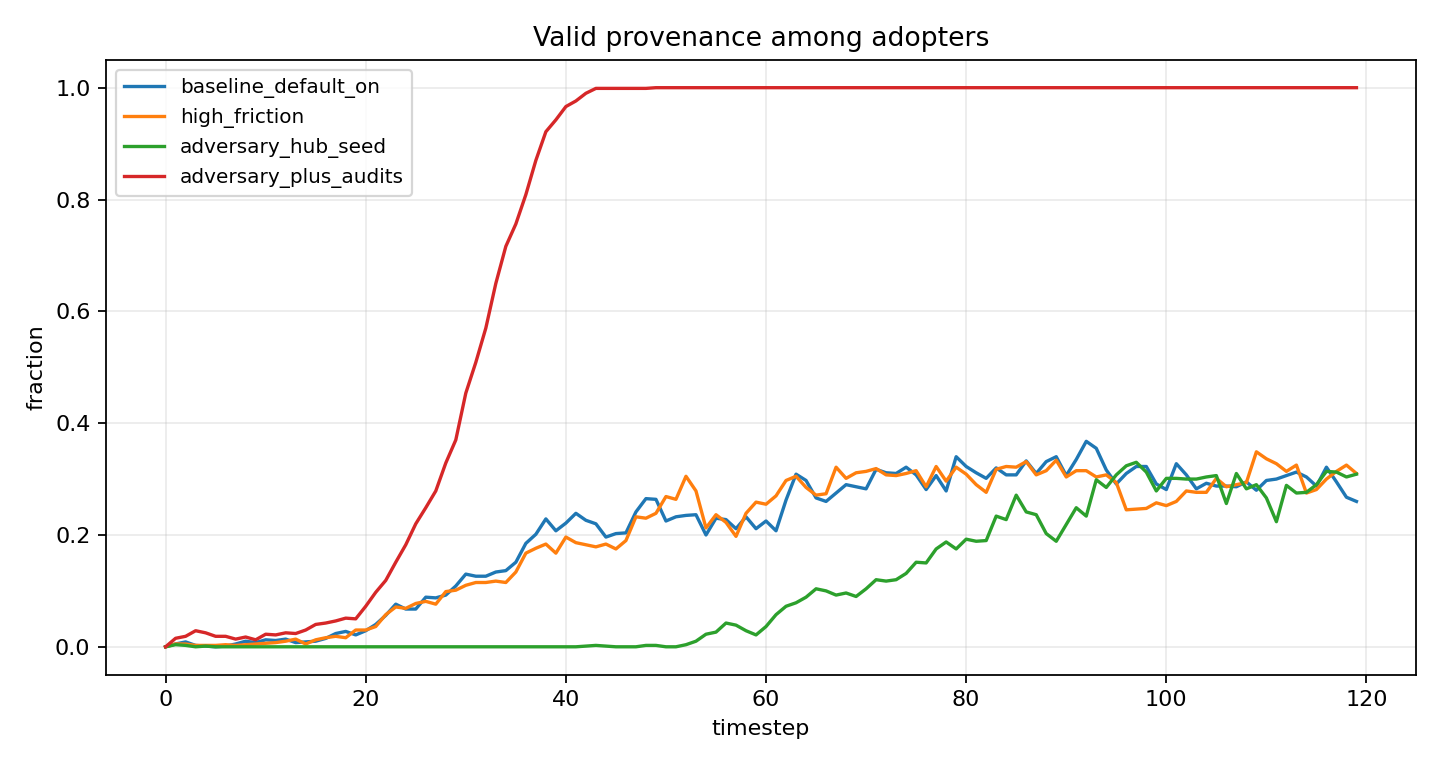
Figures below show time series for adoption, compliance, provenance validity, and incidents.
Adoption
Compliance among adopters (permission manifests + provenance enabled)
Valid provenance among actions
Incidents
Key findings (qualitative)
1) Adoption can saturate while safety collapses
Even when adoption grows smoothly, compliance can drop if permission manifests feel like “optional overhead”. In the model, a moderate increase in manifest friction causes a large decrease in sustained compliance.
Interpretation: if manifests/provenance are not boring by default, they become a tax that people route around—especially when their neighbors normalize skipping them.
2) Targeted attacks on hubs are disproportionately effective
When the adversary seeds high-degree nodes, exposure spreads faster and reaches more of the network early. That shifts local equilibria toward noncompliance (and raises the rate of “valid-looking but forged provenance”).
Interpretation: in real ecosystems, “influencers” are not only people; they are:
- popular repos
- widely copied agent templates
- default configs in agent frameworks
- LLM prompt packs
If those hubs omit manifests/provenance, they don’t just add risk—they set the norm.
3) Lightweight audits are a strong stabilizer
Adding a small audit rate (random checks of adopters) meaningfully increases norm strength and compliance, even under adversarial pressure, reducing incident rates.
Interpretation: you don’t need perfect enforcement. You need credible detection plus feedback loops that increase the local cost of noncompliance.
4) Provenance fails “silently” without strong norms
In the model, provenance validity is not only about emitting signatures; it is about refusing forged chains.
If safety norms are weak, actors accept forged provenance at high rates when exposed.
Interpretation: provenance is a socio-technical system. Cryptography helps, but if users routinely click through warnings, provenance becomes theater.
What this suggests for real systems
- Make manifests/provenance default-on and low-friction.
- Aim for “safe by construction” pipelines where manifest generation is automatic.
-
Treat “turning off provenance” like disabling seatbelts: possible, but costly and visible.
-
Defend the hubs.
- Curate and harden the top templates/repos.
-
Add provenance checks to package managers, agent registries, and framework defaults.
-
Add small-but-real enforcement.
-
Periodic audits, automated policy checks, and incident postmortems that update norms.
-
Measure what matters.
- Adoption rate alone is the wrong KPI.
- Track compliance, provenance validity, and incident rates (plus leading indicators like bypass attempts).
Limitations / next steps
This is intentionally simple. A better model would:
- separate individual vs institutional norms
- include heterogeneous roles (operators, security teams, vendors)
- model multiple competing toolchains (safe vs unsafe) with explicit switching costs
- include “shadow usage” (unreported agents)
- represent provenance as a graph of artifacts with verification policies
If you want to play with it, start with Params in sim/norm_diffusion.py and sweep:
manifest_friction,default_on_manifest_bonusadv_seed_frac,adv_targetaudit_rate
Reproducing the figures
From the repo root:
./venv/bin/pip install numpy matplotlib networkx
./venv/bin/python sim/make_plots.py
If you’re building agent systems and want to pressure-test your permissioning and provenance design against “realistic laziness + realistic attackers”, this is the kind of model worth keeping in your toolbox.